Fourth Grade, Lesson 2: Why Does the Cacao Tree Need a Tropical Rainforest to Grow?

Fourth Grade, Lesson 2: Why Does the Cacao Tree Need a Tropical Rainforest to Gr

Concept 

Cacao plants have specific requirements to survive. Plants thrive naturally in different biomes. Growing conditions and requirements can be affected by human activity.

Essential Question 

Why does the cacao tree need a tropical rainforests to grow?

Step 1 -- Connect (The Concept to Prior Knowledge)

Challenge

Where does chocolate come from? Students describe the story of a chocolate bar, including harvesting, processing, packaging and shipping.

Materials

- Research tools (Internet access, etc.)

Procedure

  1. Students are introduced to a concept map before writing their stories. Concept Mapping: As a whole class, with the teacher recording on the board, students learn to brainstorm answers to the question: Where does a chocolate bar come from? Put the words "chocolate bar" in the center of a piece of paper and begin to record all the different responses to the question. Prompts might include:
    • origin of ingredients
    • production/manufacturing sites
    • different sources of transportation
    • stores where it was bought
    • packaging and its origins, etc.
    This will create a sense of the full cost of the chocolate bar.
  2. Have each student write a short story from the perspective of the chocolate bar. Resources might include: From the Bean to the Bar: Chocolate Slideshow: This presentation takes you on a delicious journey that follows the production of a chocolate bar from the bean to your supermarket. The Sweet Science of Chocolate: This Web site provides background information on the origins of chocolate, describes how to process cocoa beans and make chocolate bars and discusses the possible health benefits of eating chocolate. Hershey's factory tour: This Web site takes you through the path that Hershey's chocolate takes from the forest to the factory. About Cacao trees, pods and seeds: These sites give an overview of what the cacao tree looks like and what part of the tree chocolate is derived from.

Step 2 -- Literature/Discuss (Give Expert Information Book; Ask Questions)

Challenge

What do cacao trees need to survive? Students will research cacao trees, focusing on the conditions necessary for growing the crop.

Materials

- Story: Romel's Rainforest Home, a Rainforest Alliance story
- Paper, pencils

Procedure

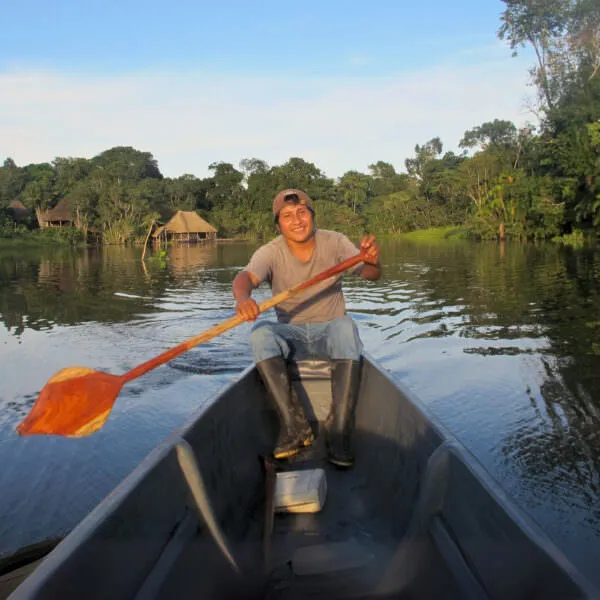
  1. Read aloud: Romel's Rainforest Home, a Rainforest Alliance original story about a Chachi boy who lives in the northwest corner of Ecuador. Discuss the different living conditions of the rainforest that Romel and his family experience.
  2. Have students talk about the conditions that exist in Romel's country that are necessary for the growth of the cacao tree.
  3. Have students write a short biome story that describes the conditions of the rainforest from the cacao tree's perspective. What does the world look life from the perspective of the cacao tree? What does the tree experience each day?

Step 3A -- Practice (Math and Learning Centers)

Challenge

Why can't we grow our own chocolate? Students compare the environmental conditions in their local region to the conditions in which cacao trees grow naturally. Students create charts and maps to organize their findings and highlight the environmental differences between temperate forests and tropical rainforests.

Materials

- Large chart paper
- Magic markers

Procedure

  1. Teachers create a large chart for the front of the classroom that will include the aspects of different biomes. A biome is a group of ecosystems that have similar climate and plant species. Select two or three examples of different biomes to be filled in as examples for students. These might include arctic areas, desert, temperate zones and tropic zones. The chart should include:
    • Climate
    • Plant life
    • Animal life
    • Space for student observations
  2. Discuss the differences in biomes around the world and how those biomes provide just the right conditions for certain kinds of plants and animals to survive. The chart should give an overview of the earth's biomes.
  3. Create a chart that can be filled in by students that describes their biome and more specifically, their bioregion. A bioregion is an area whose limits are naturally defined by features such as mountain ranges or ecosystems. This chart will be filled in by individual students and edited in small groups to further describe the place where they live. The chart should include: climate, plant life, animal life and student observations.
  4. Using the description from Romel's Rainforest Home, fill in a chart that contains what you know about the rainforest.

Step 3B -- Create (Performance Tasks Related to Standard Indicators)

Challenge

Students will compare and contrast the growing conditions of a temperate tree and the cacao tree.

Materials

- Art supplies (construction paper, glue, markers, etc.)

Procedure

  1. Half of the students in the classroom should create 3D models of cacao trees, including chocolate pods, the surrounding forest and evidence of human and other animal activity. Labels of the growing conditions (climate, rain amounts, sun, pollinators, etc.) should be placed around the tree.
  2. The other half of the classroom should create a 3D model of a local tree including the seed pods, surrounding plant life, evidence of animal and human activity as well as the growing conditions.

Step 4 -- Present (Edit Work/Students Present Projects)

Challenge

Students present their models to their peers, explaining how their tree depends on the conditions created by the tropical rainforest or temperate forest biome. After, students combine their models to create a larger tropical rainforest or temperate forest.

Materials

- 3D cacao tree models from Step 3B

Procedure

  1. Students will display their models and write a short description of the differences among the temperate and tropical trees. This should include an observation about why each of the trees might thrive or fail in the other biome.

The Rainforest Alliance curriculum is unique in that it teaches science, math, language arts and social studies essentials while addressing the United States National Standards for Learning. These are the standards addressed in the fourth grade lessons.

Language Arts Writing

Standard 4 Level 2 Grade 3 - 5
2. 3. 4. Gathers and uses information for research purposes (encyclopedias, dictionaries, electronic media).
Uses multiple representations of information (maps, charts, diagrams, tables) to find information for research topics.
7. Uses strategies to compile information into written reports or summaries.

Reading

Standard 6 Level 2 Grade 3 - 5
Uses reading skills and strategies to understand and interpret a variety of literacy texts.
9. Makes connections between characters or simple events in a literary work and people or events in his or her own life.

Standard 7 Level 2 Grade 3 - 5
Uses reading skills and strategies to understand a variety of informational texts.
5. Summarizes and paraphrases information in texts.
6. Uses prior knowledge and experience to understand and respond to new information.

Listening and Speaking

Standard 8 Level 2 Grade 3 - 5
Contributes to group discussions.
Asks questions in class.
Responds to questions and comments.
1. Listens to classmates and adults.
7. Makes basic oral presentations to class.
10. Organizes ideas for oral presentations.

Thinking and Reasoning

Standard 3 Level 2 Grade 3 - 5
4. Makes comparisons between countries in terms of relatively concrete characteristics (size, population, products).

Standard 1 Level 2 Grade 3 - 5
Uses facts from books, articles and databases to support an argument.
7. Recognizes when a comparison is not fair because important characteristics are not the same.

Standard 5 Level 2 Grade 3 - 5
Identifies issues and problems in the school or community that one might help solve.

Mathematics

Standard 1 Level 2 Grade 3 - 5
Uses a variety of strategies to understand problem situations.
Represents problems situations in a variety of forms.

Standard 3 Level 2 Grade 3 - 5
7. Solves real world problems involving number operations.

Standard 4 Level 2 Grade 3 - 5
Understands the basic measures perimeter, area, volume circumference.
Selects and uses appropriate tools for given measurement situations.
4. Understands relationships between measures.
Uses specific strategies to estimate quantities and measurements.

Standard 9 Level 2 Grade 3 - 5
2. Understands that mathematical ideas and concepts can be represented concretely, graphically, and symbolically.

Life Sciences

Standard 6 Level 2 Grade 3 - 5
Knows the organization of simple food chains and food webs.
Knows the transfer of energy.
Knows that changes in the environment can have different effects on different organisms.
Knows that all organisms (including humans) cause changes in their environments and these changes can be beneficial or detrimental.

Standard 1 Level 2 Grade 3 - 5
Understands atmospheric processes and the water cycle.

Standard 4 Level 2 Grade 3 - 5
5. Knows that the characteristics of an organism can be described in terms of a combination of traits; some traits are inherited and others result from interactions with the environment.

Standard 5 Level 2 Grade 3 - 5
Knows that living organisms have distinct structures and body systems that serve specific functions in growth, survival, and reproduction (body structures for walking, flying, or swimming).

Standard 7 Level 2 Grade 3 - 5
3. Understands the concept of extinction and its importance in biological evolution.
Knows ways in which living things can be classified.

Standard 9 Level 2 Grade 3 - 5
Understands the sources and properties of energy.

Standard 11 Level 2 Grade 3 - 5
Knows that good scientific explanations are based on evidence (observations) and scientific knowledge.
Knows that scientists make the results of their investigations public.

Standard 13 Level 2 Grade 3 - 5
Knows that people of all ages, backgrounds, and groups have made contributions to science and technology throughout history.

Standard 12 Level 2 Grade 3 - 5
Plans and conducts simple investigations.
4. Uses appropriate tools and simple equipment.

Fourth Grade Resources

Species Profiles

Additional Resources