Lesson 4: The Tropical Supermarket

Concept
Everything has a source. When we consume products from the shelves of supermarkets we are intricately connected to the ecosystem in which the natural resources originated and to the lives of those people who produced them.
Essential Question
Whose lives are we eating?
Step 1 -- Connect (The Concept to Prior Knowledge)
Challenge
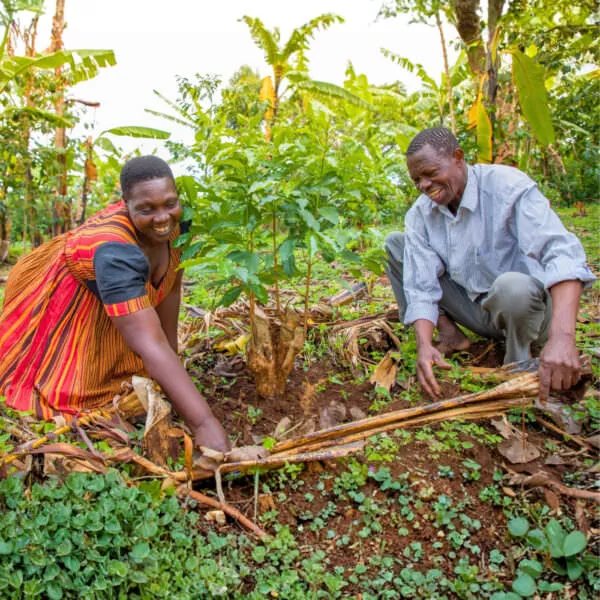
Students will understand that farmers organize their lives around growing, harvesting and delivering products to markets for other people to enjoy.
Materials
- Locally produced food (brought in by students)
- Local map
Procedure
- Students identify and bring in to school a food that is produced locally. It may be a vegetable, fruit, honey, grain, meat, etc.
- Using a map of the local area, locate where these foods are grown and how much land each takes to grow, how much time it takes to grow and what kinds of ingredients are necessary for its production. For example: How much rainfall, temperature, fertilizer or feed, soil, etc.
- Students study a local food producer. (This will be different for each geographical area.) Have the producer come into the classroom or have children visit the local farm/garden to discuss how much of their time and energy goes into producing the item of study.
- Have students write a report of the food item and all the ingredients that go into its production, including the time of the farmer.
Step 2 -- Literature/Discuss (Give Expert Information Book; Ask Questions)
Challenge
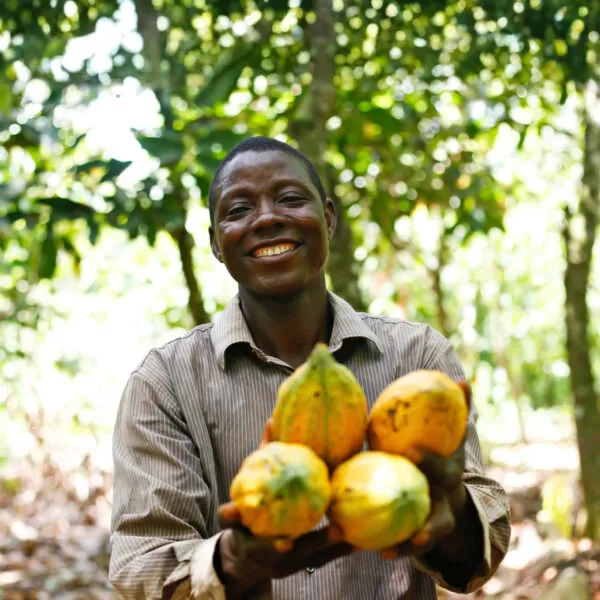
Students will understand that many lives of people in Ecuador are part of their chocolate.
Materials
- Story: Romel's Rainforest Home, a Rainforest Alliance story
- Chachi Community Profile
Procedure
- Read Romel's Rainforest Home, a Rainforest Alliance story. Use the pictures in the story to compare and contrast the students and communities the students know to those that Romel knows.
- Read the Chachi Community Profile to share information with students about the Chachi and the social environmetnal benefits of growing cocoa in the shade.
Discussion:
- What food products are the same or different in Romel's community than what you find in your supermarket?
- How is Romel's life the same and/or different than yours?
- How is his home different?
- How is the school different?
- Do you do chores at home? Are they the same as Romel's?
- How much time do you think Romel spends helping produce cocoa beans?
- Did you learn anything new about cocoa beans than you knew before after reading the story?
Step 3A -- Practice (Math and Learning Centers)
Challenge
Students will calculate the amount of space necessary to produce chocolate for their classroom.
Materials
- Paper, pencils
Procedure
- Research how much space is needed to grow 10, 20, 30 or 100 cacao plants.
- How big will Romel's farm have to be to supply enough chocolate for your classroom?
- How much space will it take to supply chocolate for 20 classrooms?
- How many acres of Ecuadorian Rainforest are left?
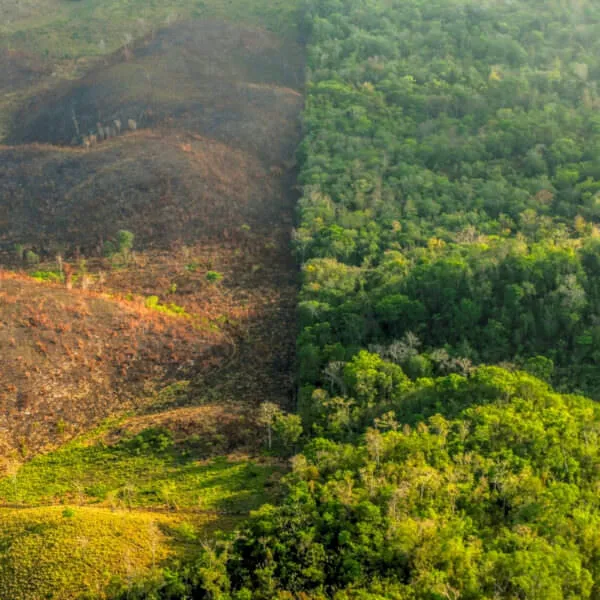
- Romel's family grows cocoa in the shade of the rainforest. How many acres of rainforest will have to be cut down if a farmer decides not to use shade-grown cocoa techniques in order to triple the amount of chocolate being produced now?
- How many acres would that leave for protected rainforest?
Step 3B -- Create (Performance Tasks Related to Standard Indicators)
Challenge
Students understand the difference between the impact of shade-grown cocoa beans and plantation cocoa production.
Materials
Procedure
- Students research different types of growing practices for cocoa.
- Students read Profiles in Sustainability and the Adopt-A-Rainforest Ecuador pages.
- Students give 2 - 3 minute speeches pretending they are Romel's uncle, the president of San Salvador, to explain the benefits of growing cocoa beans using sustainable farming practices.
Step 4 -- Present (Edit Work/Students Present Projects)
Challenge
Students describe the benefits of shade-grown/sustainable growing practices to manufacturing companies who buy cocoa beans from Ecuador.
Procedure
- Students develop research papers that describe the process and benefits of sustainable practices in the rainforest of Ecuador especially regarding cocoa beans.
- Students create an alternative buying strategy for manufacturers that supports the use of sustainable growing techniques by showing how much of the rainforest can be saved and highlighting the value of preserving its integrity for the lives of plants, animals and Chachi communities.
The Rainforest Alliance curriculum is unique in that it teaches science, math, language arts and social studies essentials while addressing the United States National Standards for Learning. These are the standards addressed in the fourth grade lessons.
Language Arts Writing
Standard 4 Level 2 Grade 3 - 5
2. 3. 4. Gathers and uses information for research purposes (encyclopedias, dictionaries, electronic media).
Uses multiple representations of information (maps, charts, diagrams, tables) to find information for research topics.
7. Uses strategies to compile information into written reports or summaries.
Reading
Standard 6 Level 2 Grade 3 - 5
Uses reading skills and strategies to understand and interpret a variety of literacy texts.
9. Makes connections between characters or simple events in a literary work and people or events in his or her own life.
Standard 7 Level 2 Grade 3 - 5
Uses reading skills and strategies to understand a variety of informational texts.
5. Summarizes and paraphrases information in texts.
6. Uses prior knowledge and experience to understand and respond to new information.
Listening and Speaking
Standard 8 Level 2 Grade 3 - 5
Contributes to group discussions.
Asks questions in class.
Responds to questions and comments.
1. Listens to classmates and adults.
7. Makes basic oral presentations to class.
10. Organizes ideas for oral presentations.
Thinking and Reasoning
Standard 3 Level 2 Grade 3 - 5
4. Makes comparisons between countries in terms of relatively concrete characteristics (size, population, products).
Standard 1 Level 2 Grade 3 - 5
Uses facts from books, articles and databases to support an argument.
7. Recognizes when a comparison is not fair because important characteristics are not the same.
Standard 5 Level 2 Grade 3 - 5
Identifies issues and problems in the school or community that one might help solve.
Mathematics
Standard 1 Level 2 Grade 3 - 5
Uses a variety of strategies to understand problem situations.
Represents problems situations in a variety of forms.
Standard 3 Level 2 Grade 3 - 5
7. Solves real world problems involving number operations.
Standard 4 Level 2 Grade 3 - 5
Understands the basic measures perimeter, area, volume circumference.
Selects and uses appropriate tools for given measurement situations.
4. Understands relationships between measures.
Uses specific strategies to estimate quantities and measurements.
Standard 9 Level 2 Grade 3 - 5
2. Understands that mathematical ideas and concepts can be represented concretely, graphically, and symbolically.
Life Sciences
Standard 6 Level 2 Grade 3 - 5
Knows the organization of simple food chains and food webs.
Knows the transfer of energy.
Knows that changes in the environment can have different effects on different organisms.
Knows that all organisms (including humans) cause changes in their environments and these changes can be beneficial or detrimental.
Standard 1 Level 2 Grade 3 - 5
Understands atmospheric processes and the water cycle.
Standard 4 Level 2 Grade 3 - 5
5. Knows that the characteristics of an organism can be described in terms of a combination of traits; some traits are inherited and others result from interactions with the environment.
Standard 5 Level 2 Grade 3 - 5
Knows that living organisms have distinct structures and body systems that serve specific functions in growth, survival, and reproduction (body structures for walking, flying, or swimming).
Standard 7 Level 2 Grade 3 - 5
3. Understands the concept of extinction and its importance in biological evolution.
Knows ways in which living things can be classified.
Standard 9 Level 2 Grade 3 - 5
Understands the sources and properties of energy.
Standard 11 Level 2 Grade 3 - 5
Knows that good scientific explanations are based on evidence (observations) and scientific knowledge.
Knows that scientists make the results of their investigations public.
Standard 13 Level 2 Grade 3 - 5
Knows that people of all ages, backgrounds, and groups have made contributions to science and technology throughout history.
Standard 12 Level 2 Grade 3 - 5
Plans and conducts simple investigations.
4. Uses appropriate tools and simple equipment.
Fourth Grade Resources
- Fourth Grade Curriculum
- Ecuador Slideshow [PDF]
- Ecuador Slideshow script [PDF]
- Chocolate Slideshow [PDF]
- Romel's Rainforest Home [PDF]
- El Hogar de Romel en el Bosque Tropical [PDF]
- Romel e seu Lar na Floresta [PDF]
Species Profiles
- Bromeliad [PDF]
- Ocelot [PDF]
- Great Curassow [PDF]
- Capuchin Monkey [PDF]
- Three-Toed Sloth [PDF]
Additional Resources
- Adopt-A-Rainforest: Ecuador Page
- Teacher Summary: Chachi Community Profile, Ecuador [PDF]