Teachers

Get Involved
Support Our Work
Programs
Research & Resources
Email This Page
Contact Us
Site Map

Learning Site

Kindergarten

Kindergarten

Cachalú Biological Reserve, Colombia


Lesson 3 -- Biodiversity

Sign up here for our free monthly

e-newsletter.

Concept

Rainforests are comprised of an extraordinary diversity of plants and animals. Diversity of life is an essential ingredient to healthy ecosystems.

Essential Question

Which forest, a tropical rainforest or temperate forest, is more diverse and by how much more?

Total Time

120+ minutes

Objectives

1. Students will identify and group different types of insects and trees in their

    local forest.

2. Students will create visual representations of plants and animals of temperate

    and tropical rainforests in order to illustrate the relative differences in

    diversity.

3. Students will explain to classroom guests how the diversity of life in a

    temperate forest compares to the diversity of life in a rainforest.

View Lesson Plan


Additional Resources

Slideshow – Click below for a slideshow and script about the Cachalú reserve

  that includes background information about the animals, people and landscape

  of this region. The slideshow can be downloaded for viewing in the classroom,

  or printed out and read as a story, or viewed online with the students.

                    Download as PDF [~5.5M]             View On-Screen

                    Download script as PDF [~17K]

Chayo’s Andean HomeA Rainforest Alliance original story that teaches

  children about the animals that Chayo sees on the farms and what her family is

  doing to help protect the forest.

            English:   View on Screen          Download [PDF ~2.3M]
            Spanish:   View on Screen         
Download [PDF ~664K]
            Portuguese:  View on Screen          Download [PDF ~664K]

Species Profiles – Profiles include: photos, habitat, foraging behavior, group

  relationships, threats, etc.

− Spectacled Bear            View on Screen      Download [PDF ~71K]

− Nine-Banded Armadillo     View on Screen      Download [PDF ~64K]

− Cock of the Rock            View on Screen      Download [PDF ~40K]

Leaf-Cutter Ant             View on Screen      Download [PDF ~36K]

Andean Condor              View on Screen      Download [PDF ~43K]

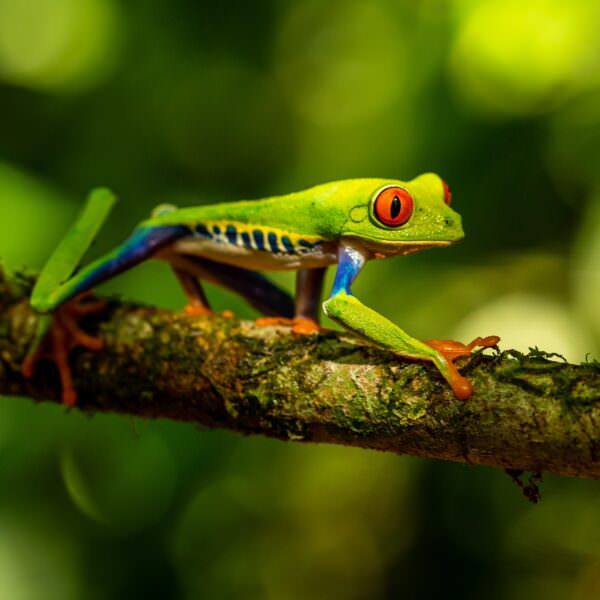
− Red-eyed tree frog         View on Screen      Download [PDF ~47K]

Coloring Pages

         - Spectacled bear           Download [PDF ~217 K]
         - Red-eyed tree frog        Download [PDF ~217 K]

Rainforest Products – Click here for a summary of products that we use in our

  everyday lives that originate in rainforests. Both teachers and students will find

  information on the products found in their homes and supermarkets that either

  originated in tropical forests or are currently produced there.


Conservation Coffee Summary – This summary includes the environmental,  

  social and cultural impact that coffee has had on the Americas, the connection  

  between coffee farms and wildlife and a glossary of relevant terms. 

  Download [PDF ~92K]

Rick and the Gang Find Out Why Some Coffee is Bad for BirdsThis article   from Ranger Rick Magazine describes the impact some coffee harvesting

  techniques have on bird habitat.  Download [PDF ~5.7M]

Profiles in Sustainability – Click here for case studies on companies who

  work closely with the Rainforest Alliance to ensure that their practices protect

  wildlife, workers and communities.

Sample Parent Letter – Download a sample parent letter to be used as part

  of the unit.   Download [PDF ~18K]

Certificate of Accomplishment – Print out colorful rainforest certificates for

  your students to commemorate their completion of these units.  

   Download [PDF ~594K]

Great Resources – Check out this page for easy access to additional

  supplemental materials that complement these dynamic units.


Informational Introduction for the Teacher 

This lesson challenges students to examine the diversity of their own forest and make comparisons to a tropical rainforest. By exploring and grouping tree and insect types in their local forest, students will develop an understanding of diversity. This data will be compared to what is known about tropical rainforests, helping students to appreciate the tremendous amount of life in the tropics.


STEP 1 - CONNECT (The Concept to Prior Knowledge)             45 minutes

Challenge

Students predict how many different types of insects and trees they will be able to find in a small area of a local forest and a tropical rainforest.  Students collect data in their local forest and compare their findings with their original predictions. They then compare their findings with what others know about tropical rainforests. 


Materials (per class)

-Colorful ribbons to mark perimeter of study area.

Materials (per 2 students)

-Plastic containers for capturing insects for observation-Nets for collecting insects.

-2 copies of Chart 1- Local Forest: Tree and Insect Diversity

-2 copies of Chart 2- Tropical Rainforest: Tree and Insect Diversity

Procedure

1. Read aloud the introduction for students, above.

2. Ask students to predict how many different kinds of insects and trees live in a

   40’ x 40’ area of their local forest (compare the area to the size of your

   classroom). Help the class realize that counting different types of insects and

   trees is different from counting the total number of insects and trees. Explain

   that although your classroom is filled with a diversity of children -- that is,

   children of different ages, sizes, colors, parents, etc…- they all are considered

   one type of animal called Homo sapiens. Have students write down their name

   and prediction on a piece of scrap paper and give to you.

3. Show students a large picture of a spider and an insect (of your choice). Ask      students which one of these two animals is not an insect. Describe that

    insects must have 6 legs and 3 distinct body parts. Ask students to say aloud

    how they will know if they’ve discovered an insect in their area.

4. Show students a pile of woody and herbaceous (herb-like or non-woody)    

    branches/twigs. Ask for volunteers to sort the twigs into two piles; one that

    they think came from trees and the other they think came from other plants.

    Elicit their ideas for telling the difference between a plant and a tree. 

    Demonstrate the correct sorting (trees have woody branches and stems

    whereas non-tree plants have fleshy-like branches and stems). 

5. Ask students to write down the number of different types of insects and trees

    they think they will find using Chart 1. Tell students they will compare their 

    predictions to what they actually find.


Chart 1 - Local Forest: Tree and Insect Diversity


CHART 1

Trees

Tree

# of types

Insects

Insect

# of types

Guessed

Question Mark

(Student indicates prediction here.)


Found

telescope


Actual

Smiley face


6. Find a natural forested area to explore with your class and mark with colorful 

    ribbons a 40’ x 40’ area that is representative of the larger forest.

7. Have students work in pairs and count the number of different trees and

   insects they find within the marked area. Ask students to share their ideas for

   how they plan to avoid counting the same item two or more times.

8. Tell students that insects may be found in the air, on trees and plants and on

    the ground.

9. Tell students they have 15 minutes to find as many different types of insects

    in the area. They should write this number next to their insect prediction

    number and circle it.

10. Tell students they have 15 minutes to find as many different types of trees in

     the marked area. They should write this number next to their tree prediction

     number and circle it.

11. Ask a team of students to show the entire class all the different trees they

     found in the area. Asks another pair if they agree with the first team’s count:

     Did they repeat any? Did they miss any?

12. After returning to the classroom, ask students to record their findings in the      “Found” row under the insects and trees headings in their chart.

13. Help students figure out the differences between their predictions and what

     they observed.

14. Ask, “Why might our number of different types of insects found not really

     show the actual number of insects that live in your type of forest?”

15. Ask students to imagine how many different types of trees and insects they

     think could be found in the same size area of a tropical rainforest.  Tell

     students to write their predictions in Chart 2.


Chart 2 - Tropical Rainforest: Tree and Insect Diversity


CHART 2

Rainforest Tree

Rainforest Tree photo

# of types

Rainforest Insect

Butterfly photo

# of types

Guessed

Question Mark

(Student indicates prediction here.)


Found

telescope


Actual

Smiley face


16. After students have made their predictions, reveal the actual figures for a

     typical 40’ x 40’ plot of tropical rainforest. 

Tropical rainforest trees:               50*                      Tropical rainforest insects:             312**

*Rainforest areas typically have 10 times more tree species than temperate forest   patches of the same size.  If students found 5 types of trees in their local forest,   the corresponding rainforest figure is 50.

**One hectare of rainforest may contain up to 42,000 species of insects. This equates to 17,004 species in one acre. Scaling down further, a 40’ x 40’ area contains 1,600 square feet of space- approximately 4% of an acre. This equates to 312 insects. 

Source:  Sayer, April Pulley. Tropical Rainforest, Twenty-First Century Books, New York

17. Ask students to copy the “actual” numbers into Chart 3 so it looks like this:


       Chart 3 - Local and Tropical Rainforest: Tree and Insect Diversity


CHART 3

Trees

Tree Image

# of types

Insects

Beetle image

# of types

Rainforest Actual

Rainforest image


Temperate Forest Actual

Temperate forest image


18. Tell students that they will use their charts later in their unit.


STEP 2 - LITERATURE/DISCUSS (Give Expert Information Book; Ask Questions)                                                                                                                                                                                                     15 minutes

Challenge

Students are read a book about tropical rainforests and learn that there are an impressive number of different types of plants and animals that live in the rainforest.

Materials

-The book A Walk in the Rainforest by Kristin Joy Pratt.


Procedure

1.  While reading A Walk in the Rainforest,* ask questions such as: 

    • How many different types of animals and plants do you see in each picture?How is the diversity of the tropical rainforest different from the diversity in our forest?Why do you think tropical rainforests are more diverse than temperate forests?
    • How can so many different types of animals and plants live in the rainforest at the same time?
 

Nb. *The introduction to A Walk in the Rainforest provides a good summary of the concept of biodiversity and describes how much diversity exists in rainforests. The following descriptions may also be helpful in expressing how diverse rainforest are:

“The rainforest is an ideal place for many types of animals to live. There is plenty of water, shelter and food, and it is warm all year. These conditions mostly benefit the insects, which can grow and reproduce the year round, unlike the annual cycle in colder climates. Some insects grow very large. "Walking sticks" reach lengths of over 12”.  Beetles can be as large as your hand and some moths are the size of small birds. But the really amazing thing about them is their variety. One tree in the Amazon can house 200 different types of insects; not 200 insects but 200 different types! Scientists believe many insects that live in the rainforest have yet to be named and catalogued.”  (Source: www.tropical-forests.com/)


STEP 3A - PRACTICE (Math and Learning Centers)                      20 minutes

Challenge

Students create simple bar graphs to illustrate the relative diversity of trees and insects between their local forest and a tropical rainforest.

Materials (per 2 students)

-Large butcher paper for graph

-Chart 3 from Step 1-Scotch tape-Approximately 60, 1” x 1” square pieces of paper-Colored markers, crayons, etc. for coloring pictures

Procedure

1. Post a large representation of Chart #3 used in Step 1 with the appropriate

   data.

2. Ask the following questions:

a. What do you notice about the difference between the number of insects/trees found in a tropical rainforest and a temperate forest?

b. How many more types of insects are found in the tropical rainforest than in a temperate forest?

c. How many more types of trees are found in the tropical rainforest than in a temperate forest?

3. Tell students that they are going to make a picture that will show a

    comparison between the number of different types of trees “actually” found

    by experts in a typical 40’ x 40’ area of their local forest and a tropical

    rainforest.

4. Give each pair of students a large piece of butcher paper. Ask them to copy

    your illustration of a large graph onto their paper. Tell them to make a quick

    sketch of a tree with a “#” next to it to indicate number of tree types. Ask

    them to put a “Te” and a “TR” along the horizontal axis and explain that

    the “Te” stands for a temperate forest and the “TR” stands for tropical

    rainforest.

5. Ask students to look at Chart 3 and tell you the actual number of different

   types of trees experts indicate are found in a 40’ x 40’ area of a temperate

   forest and tropical rainforest. Determine the average number of trees found

   and work with that for the rest of this activity.

6. Give pairs of students the materials listed above. Tell students that each 1”

    square piece of paper represents a different type of tree. Their goal is to

    tape, end to end on their graphs, the number of different types of trees found

    in the temperate forest and tropical rainforest. Start by taping one tree on

    the horizontal axis, and add each tree type vertically.

7. When all of the 1” squares are taped, to their graphs, ask students:

a. What does the graph tell you?

b. What other comparisons would you like to make between the diversity of temperate and tropical rainforests?


STEP 3B - CREATE (Performance Tasks Related to Standard Indicators)                                                                                                              30+ minutes

Challenge

Students use real data to create 2 and 3-dimensional visual representations to illustrate the comparative diversity of different kinds of life in a temperate and tropical rainforest.

Materials (per student)

-Data on plant and animal diversity

-Art supplies

Procedure

1. Tell students that their challenge is to create a new way to illustrate the

    difference in diversity between the number of ants, birds, fish and/or trees in

    a tropical rainforest and a temperate forest.

2. Tell students they may choose a plant or animal from the list below and create

    a picture, terrarium or model to illustrate how many different types of plants/

    animals there are in each forest. For example, a student may draw a picture

    of two forests, one of a temperate forest containing 10 different types of

    trees, and one of a tropical rainforest containing 100 different types of trees  

    (i.e., different color, shape, size, pattern, etc.). Other ideas include

    collections of origami birds, or constructed models of the plants and animals.

    Use the data chart below to guide their comparisons.


  Area Temperate Forest Tropical Rainforest
Ants One tree 4 types 43 types
Birds 40'x40' area 10 types 50 types
Fish Small river 10 types 80 types
Trees 40'x40' area 10 types 100 types

3. Help students figure out what types of supplies they can use to represent the     different types of plants or animals in their comparisons. 


STEP 4 – PRESENT (Edit Work/Students Orally Present Projects)                                                                                                                  20+ minutes

Challenge

Students display their projects to older students and family members and explain what they know about the biodiversity of the two types of forest. 

Materials

-Exhibits created in Step 3b

Procedure

1. Designate a space for each student in the class to set up his/her project.

2. Tell students that they will be expected to explain several aspects of their

    project:

a. Which part of the project represents the temperate forest and which represents the tropical rainforest?

b. Which type of forest contains a greater diversity of life?

c. If diversity in this project doesn’t mean different sizes of the same animal, then what does diversity mean?

3. Invite members of the school and family community to view the exhibitions.


LESSON 3 ASSESSMENT RUBRIC: 

Teacher observations of tasks with rubrics as listed below, as well as collected work samples.

Assessment Guidelines

3 = P

(Proficient)

2 = S

(Satisfactory)

1 = NW

(Needs Work)

1. Student works well with partner to collect data on diversity of insects and trees in their local forest. Student is thorough in exploring, and works hard at sorting trees and insects into different groups.


2. Student explains how initial predictions compared to actual data. Student can determine from data which forest has more diversity of trees and insects.


3. Student accurately represents the provided data in 2D or 3D form. The project includes both rainforest and temperate forest representations. Student uses creativity to compare the chosen plant/animal. 


4. Student is able to explain how the representation illustrates the difference in diversity between the two forests. Student is able to explain which forest sustains a more diverse population of the chosen plants/animals and by how much.


Top of Page