When we initially started designing our Regenerative Agriculture Standard, we knew one thing for sure: “regenerative” should be more than a label—it should be a measurable outcome. Now that it’s here, we are leaning on this concept to help scale up the global transition to a model of agriculture that gives back more than it takes.
While the standard itself is a recent development, regenerative practices and principles are nothing new to the Rainforest Alliance. In many ways, this is the standard we’ve been writing since our early days. Drawing on decades of learning from our certification program, landscape work, and field projects, we have built a standard that helps farmers and companies turn their regenerative ambition into real-world impact.
But when we talk about impact, what exactly do we mean, and how do we achieve it?
In this article, we break down how the standard drives positive change for people and nature. The following sections—highlighting the five key impact areas—are linked to a set of specific practices and tied to a broader data framework that helps us measure and understand real progress.
Five key impact areas
Tracking what matters: a data-driven approach
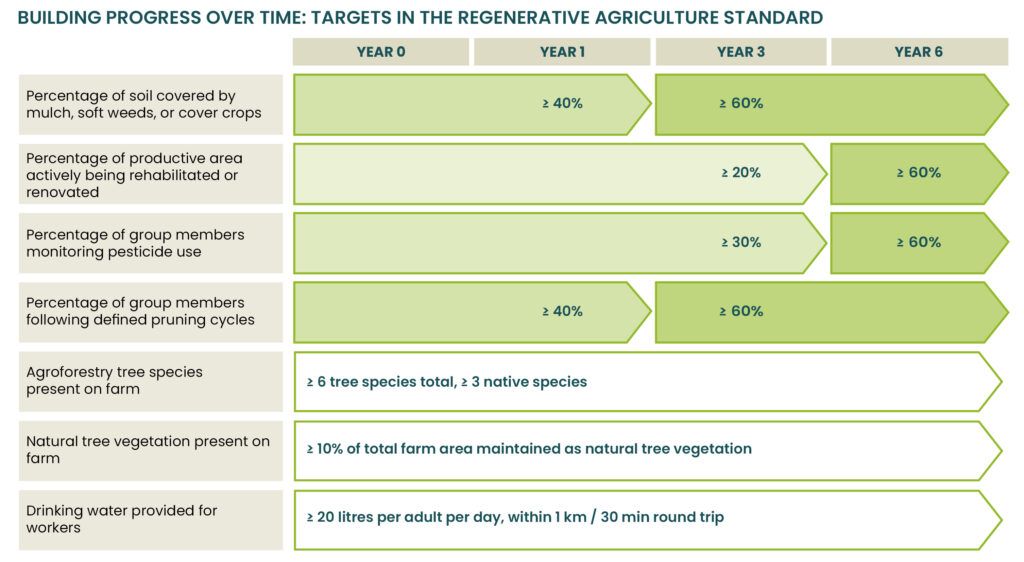
Putting regenerative practices in place is a start, but what comes next is just as important. That’s why the standard includes a robust data framework designed to support continuous improvement and track key indicators over time.
For companies, this means practical guidance and data points they can use to help meet their regenerative goals—like SDGs or net-zero targets—and assess supply chain risks. For farmers, it’s a tool to understand what’s working and where to improve. For us, it ensures that “regenerative” is more than a label—it’s real, measurable progress.
Get certified: how to start
As we roll out our Regenerative Agriculture Standard—starting with coffee in 2026 and expanding to other crops at a later date—we’re supporting our partners with crop-specific guidance and tools that reflect local realities. It’s this grounding that makes our Regenerative Agriculture Certification meaningful, valuable, and credible among farmers.
To start your regenerative journey with us, visit our Regenerative Agriculture Certification page or get in touch with us.