As expectations for sustainability performance continue to rise, so does scrutiny of sustainability claims.
Today, companies can choose from a growing range of approaches to demonstrate and validate their sustainability commitments and performance, from company-led sustainability programs and industry initiatives to verification schemes and certification systems. Each of these approaches can play a valuable role in driving positive change. Yet they are often discussed as though they provide the same level of assurance.
Assurance: Demonstration that specified requirements relating to a product, process, system, person or entity are fulfilled – ISEAL Adapted from ISO/IEC 17000:2020
In reality, they serve different purposes and offer different levels of independence, transparency, and accountability, the combination of which is what ultimately determines credibility.
Understanding these differences matters. For companies seeking to build trust with consumers, investors, business partners, regulators, and civil society, the strength of a sustainability claim depends not only on what is being claimed, but also how robustly that claim is substantiated.
Verification, certification, and company-led schemes: What’s the difference?
One of the most common sources of confusion is the distinction between verification, certification, and company-led schemes.
Verification typically confirms whether a specific claim, dataset, or outcome is accurate. It can be carried out internally, or by a second- or third-party verifier, and is often focused on a particular project, report, or performance claim, providing assurance at a specific point in time rather than confirming performance on an ongoing basis.
Certification, by contrast, assesses whether an organization, farm, or supply chain actor consistently meets a defined set of requirements set by an independent standard-setting body. These requirements are assessed using standardized methods, by conformity assessment bodies that are independent of the organization being assessed and independently accredited to carry out that role. Rather than examining a single claim, certification evaluates the systems, processes, controls, and practices that underpin performance and requires ongoing oversight.
Company-led schemes similarly assess whether a company consistently meets a defined set of requirements, but here, those requirements (and typically the methods used to assess them) are usually set and maintained by the company itself, rather than by an independent body. Even where a company brings in a third party to check its performance, that assessment is carried out against a company-defined rather than standardized methodology, and does not result in certification. This gives companies the flexibility to define requirements that reflect their own context and priorities.
The table below summarizes some of the key differences.
| Feature | Company-Led Scheme / Self-Assessment* | Second- or Third-Party Verification* | Robust Third-Party Certification** |
| Primary purpose | Demonstrate company commitments or progress | Confirm a specific claim, dataset, or outcome | Assess conformity with a multi-stakeholder, publicly available standard |
| Scope | Company-defined | Usually claim- or project-specific | System-wide assessment of outcomes and the management systems and practices that deliver them. |
| Independence | Internal | Varies | Independent third party |
| Requirements | Company-defined | Claim-specific methodology | Publicly available standard |
| Who conducts the assessment? | Internal or company-contracted verifier | Internal or company-contracted verifier | Accredited, independent certification body |
| Ongoing surveillance | Rare | Usually no | Yes |
| Grievance mechanisms | Limited or absent | Rare | Formal, transparent, and publicly accessible |
| Stakeholder governance | Limited | Limited | Multi-stakeholder |
| Transparency | Varies | Varies | Typically high, including periodic public reporting |
| Extent of alignment with the ISEAL Code of Good Practice for Sustainability Systems | Very limited; rarely benchmarked against ISEAL | Partial; some elements align but not systematic | Strong; most credible systems are ISEAL code compliant |
| Chain of custody | Internal tracking only, if it exists; not independently verified | Usually not covered; typically claim- or transaction-specific rather than system-wide | Formal chain of custody model (e.g., identity preserved, segregated, mass balance), independently audited across the supply chain |
| Outcome | Internal assurance | Verification statement | Certification decision and certificate |
Note on this comparison: This table reflects general patterns observed across company-led schemes, second- and third-party verification approaches, and robust third-party certification systems. Individual schemes vary, and some company-led or second-party approaches may exhibit stronger practices in specific areas than this table suggests. The comparison is intended to illustrate typical differences in governance and assurance design, not to characterize any single scheme.
*Sophisticated company‑led or second‑party approaches can incorporate external audits, robust data systems, and corrective action processes. The distinction is not that these systems inherently lack rigor, but that governance, standard setting, and assurance ultimately remain tied to the company itself.
**Robust third-party certification describes certification schemes that combine independent, accredited assessment against a publicly available standard with ongoing surveillance, formal and transparent grievance mechanisms, multi-stakeholder governance, and high transparency. This is typically reflected in alignment with the ISEAL Codes of Good Practice. Not all third-party certification schemes have all of these features; this distinction is why the term “robust” is used rather than treating third-party certification as a single, uniform category.
Each of these approaches has its place. But when the goal is to provide credible, independent assurance that sustainability requirements are being met, third-party certification offers distinct advantages.
Why third-party certification provides stronger sustainability assurance
The defining feature of third-party certification is the strength of its overall assurance system. Independent assessment is central, but so are clearly defined assurance rules, oversight of Certification Bodies, corrective action processes, complaints and grievance mechanisms, and consequences for non-compliance.
In a third-party certification system, the organization setting the requirements, the organization being assessed, and the organization conducting the audit are separate from one another. Requirements themselves are set through a multi-stakeholder process that brings together representatives from different sectors in balanced proportion, rather than being defined by any single company. This independence, at both the standard-setting and audit level, helps reduce conflicts of interest and increases confidence in the results. Equally important, credible certification systems establish controls that track certified volumes, transactions, and claims through the supply chain, a system known as “chain of custody.” This helps companies substantiate their sourcing claims and avoid a disconnect between certified production and market claims.
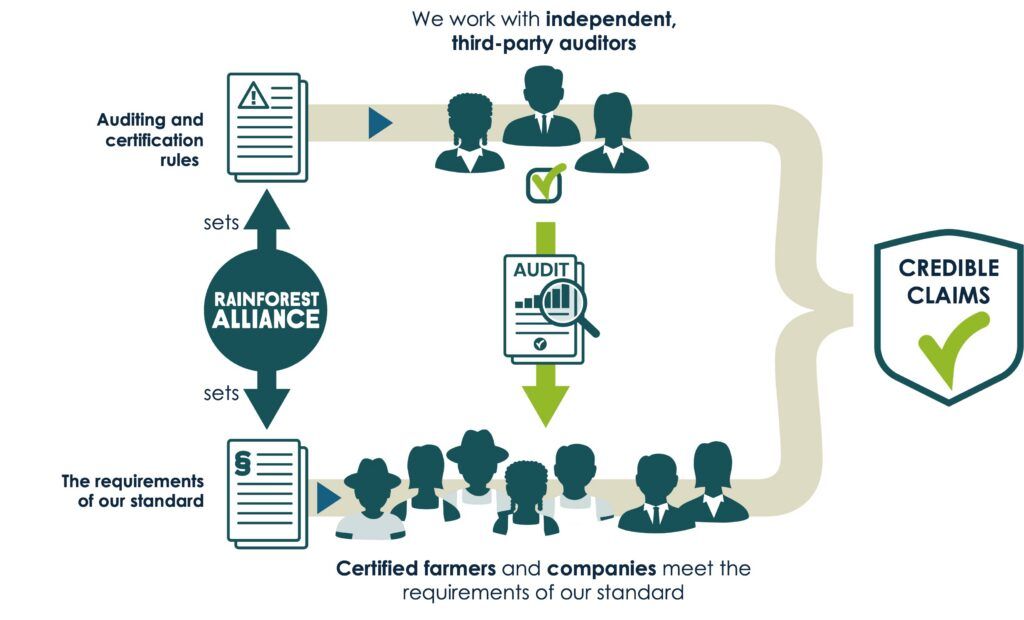
In the Rainforest Alliance certification system, shown in the image above, the Rainforest Alliance develops and maintains the standard, while compliance with that standard is assessed by independent Certification Bodies. To be authorized, these Certification Bodies must be accredited to internationally recognized standards and operate under strict impartiality requirements. They remain subject to ongoing oversight by the Rainforest Alliance: a dedicated monitoring team evaluates Certification Body performance through regular performance audits, with sanctions ranging up to withdrawal of authorization where audit quality or system integrity is compromised. The Rainforest Alliance also applies specific rules to limit conflicts of interest, such as requiring Certification Bodies to rotate their lead auditors periodically. This helps ensure that no single relationship between a Certificate Holder and its Certification Body can compromise audit integrity over time.
Other key features of third-party certification
- Transparency. Requirements are publicly available, assurance rules are clearly defined, and stakeholders can understand what is being assessed and how compliance is determined. This transparency helps build trust and enables meaningful scrutiny.
- Accountability. Third-party certification systems typically include corrective action processes (such as the Rainforest Alliance’s Remediation Protocol, which sets time-bound corrective actions for identified non-conformities), complaints and grievance mechanisms, surprise audits conducted by Certification Bodies, independent oversight of those Certification Bodies, and the possibility of certification suspension or withdrawal when requirements are not met. These mechanisms help ensure that certification is more than a claim—it is backed by a credible assurance process.
- Multi-stakeholder governance. Robust certification standards are typically developed through consultation with farmers, companies, NGOs, technical experts, auditors, and other stakeholders. This helps ensure that standards reflect a broad range of perspectives and expertise, rather than the priorities of a single organization. Standard development is also guided by established principles and procedures that promote a credible, transparent, and consistent process. At the Rainforest Alliance, this includes our Standard Development Procedure, our Standards Committee (made up of both internal and external experts, which reviews stakeholder feedback and approves draft standards), and our commitment to the ISEAL Code of Good Practice for Sustainability Systems.
- Ongoing surveillance. Unlike many verification processes, which often focus on a specific claim at a specific moment in time, certification requires yearly surveillance, monitoring, and periodic re-audits. Companies and farms must continue demonstrating compliance to maintain their certificate.
The role and limitations of third-party audits
Audits are a critical component of third-party certification. Conducted by independent Certification Bodies, they assess whether farms and companies meet defined requirements and identify areas where corrective action is needed.
Yet audits are not without limitations. Because they take place periodically and are planned in advance, they provide a snapshot in time and may not always uncover issues that can be hidden from auditors. This is particularly true of human rights violations such as child labor, forced labor, discrimination, or restrictions on freedom of association. Rather than confirming the absence of such issues, audits assess whether the systems, processes, and controls are in place that can reasonably be expected to reduce their occurrence and improve sustainability performance over time. Audits alone cannot address the systemic causes behind these challenges, and certification should therefore not be understood as a guarantee that violations will never occur.
Rather, credible certification systems provide an independent framework for identifying, addressing, and reducing risk. Certification is not simply a pass/fail mechanism. When issues are identified, there is a structured pathway to address them and improve performance over time. This is particularly important for complex social and environmental issues, where disengagement or simply removing a farm or company from a certification system may not address the underlying problems or improve conditions.
Robust third-party certification systems are designed with these limitations in mind. They combine independent audits with proactive risk management, stakeholder engagement, grievance mechanisms, internal monitoring, remediation processes, and ongoing oversight of certification bodies. Risk-based and surprise audits can provide additional scrutiny, while accreditation, training, and performance monitoring help promote consistent audit quality.
The value of third-party certification therefore does not rest on the assumption that a single audit can identify every issue or that certification guarantees perfect performance. It lies in placing independent audits within a broader system for preventing, identifying, monitoring, and remediating problems over time. Together, these elements provide a clearly defined and accountable framework for continuous improvement and help make third-party certification one of the most robust assurance models available.
Why independent sustainability assurance matters now
As the bar for sustainability claims continues to rise, the quality of the evidence behind those claims is becoming more important. Third-party certification helps meet that need: it gives companies independent evidence they don’t have to generate alone, strengthening credibility with customers, regulators, and civil society.
Regulations such as the EU Deforestation Regulation (EUDR), Corporate Sustainability Due Diligence Directive (CSDDD), Corporate Sustainability Reporting Directive (CSRD), and Empowering Consumers Directive (EmpCo) are raising expectations around transparency, substantiation, and accountability. While certification does not replace a company’s legal due diligence obligations, it can support companies by providing the independent evidence and assurance that those obligations increasingly require.
Reflecting this trend, European Commission guidance on the EUDR notes that self-declaration schemes lacking third-party assessments are inherently less robust because they lack the same level of independence and impartiality. Likewise, under the EmpCo, certification schemes must be third-party verified to qualify as certification schemes.
Building trust and scaling change through independent certification
When it comes to advancing sustainability across complex global supply chains, company-led programs, industry initiatives, verification systems, and third-party certification all have important roles to play. But understanding the distinctions and limitations of each is key to scaling meaningful change while maintaining trust. When stakeholders need confidence that sustainability requirements are being assessed independently, transparently, and consistently, third-party certification provides the strongest foundation for ensuring credible claims. That is why, across sectors and around the world, it continues to be recognized as one of the most robust models for independent sustainability assurance—built on principles of clear governance, impartial assessment, and accountability that regulators like the European Commission are now writing into law.
At its core, third-party certification connects company commitments with independent evidence of what is happening on the ground. That connection gives greater weight to the claims behind the products people buy, source, and invest in, helping markets become one of the most powerful drivers for progress.